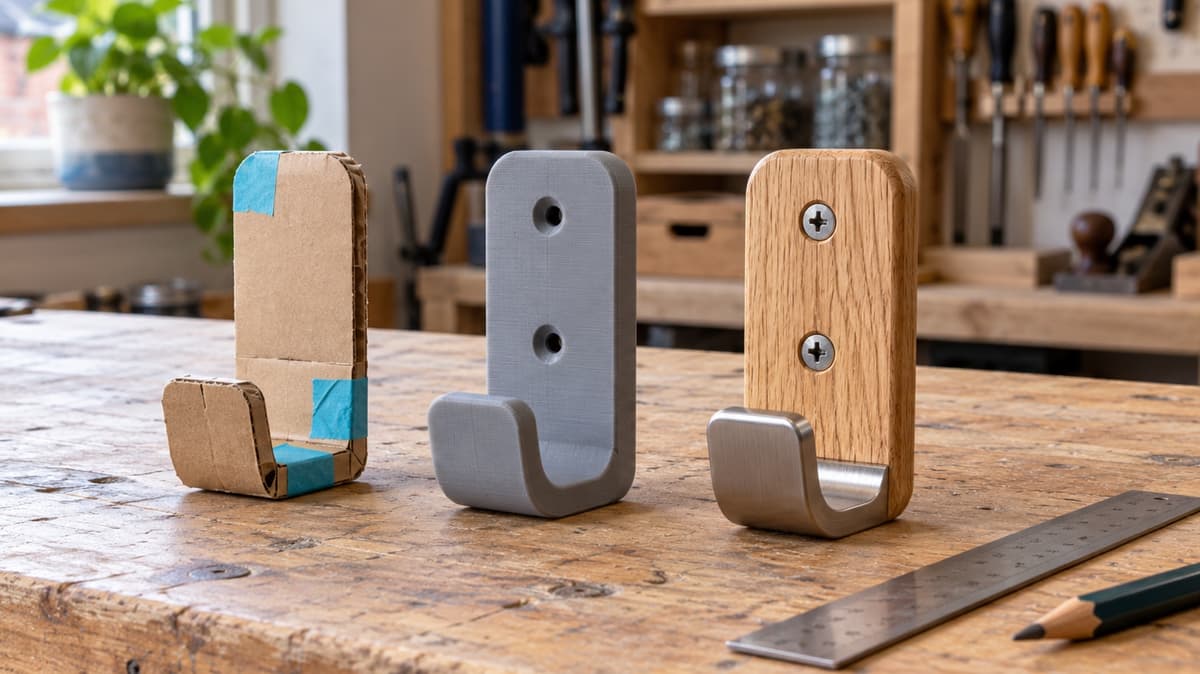
A rough cardboard shape, a 3D-printed test piece and a carefully finished working model can all be prototypes. They may look completely different because they are meant to answer different questions.
That distinction matters. People often imagine a prototype as a nearly finished product, only made once. In practice, a useful prototype might test whether something fits a hand, clears a doorway, holds a component, survives repeated movement or makes sense to the person using it. It can be deliberately incomplete. What matters is whether it creates reliable evidence for the next decision.
This is particularly relevant in October 2026. Connected Places Catapult is preparing an online session for UK hardware SMEs about moving from a prototype to a pilot or first small batch. Its description makes the challenge clear: when a team needs five, ten or fifty units, tooling may not yet be justified, the design may still be changing and not every detail needs to represent the final product. The team must decide what it needs to learn and what the test objects must reproduce faithfully.
The scale is different, but the same principle applies to a household Project, a repair, a custom item or an invention.
Start with the uncertainty
Before choosing a material or process, write down the question that is hardest to answer from a sketch.
Will the handle be comfortable? Does the enclosure leave enough room for the cable? Can a person reach the control while wearing gloves? Will the replacement part line up with the original fixing points? Does the object feel stable when placed on an uneven floor?
These questions lead to different prototypes. A foam model may be enough to test grip and proportion. A paper template can check an outline. A simple printed part can check fit. A rough wooden mock-up can test height and reach. A working electronic assembly may be necessary to test behaviour, but its outer appearance could remain unfinished.
The Design Council advises asking for the simplest thing that can test the thinking. It might be a sketch, drawing, paper prototype or mock-up. That is a useful guard against building too much too early.
Finish can hide uncertainty
A polished model is persuasive. That can be helpful when presenting an idea, but it can also create false confidence. People may discuss colour, texture and small visual details while overlooking whether the underlying arrangement works.
This does not mean appearance is unimportant. If the question concerns desirability, visual balance or how an object belongs in a room, then appearance may be exactly what needs testing. The point is to match the level of finish to the question.
A prototype should be realistic where the evidence depends on realism. It can be simplified everywhere else. Connected Places Catapult describes this as deciding what must be representative and what can be simplified without compromising the trial. For a Customer and Maker, that might mean using inexpensive sheet material to test size before producing the final piece in hardwood, or making only the awkward corner of a larger assembly before committing to the whole object.
One prototype rarely proves everything
A model that checks fit may say nothing about long-term strength. A working mechanism may not represent the final material. A visual render may communicate the idea but reveal nothing about weight, balance or assembly. Even a successful prototype only supports the questions it was designed to answer.
This is why notes matter. Record what version was tested, what changed, what happened and what remains unknown. Photograph the test from useful angles. Keep the critical dimensions. If people tried the object, record the task they attempted rather than relying on a general impression that they liked it.
The Design Council's account of the Double Diamond places prototyping and testing inside a wider cycle of developing, testing and refining possible solutions. A prototype is therefore not a verdict. It is part of an iteration.
The process matters as much as the technology
3D printing is often associated with prototyping because it can produce complex, customised forms without conventional production tooling. A 2025 government report on adoption among SMEs identifies prototyping, customised manufacturing and rapid tooling as three important uses. It also records barriers including skills, technical challenges and uncertainty about where the technology is useful.
The lesson is not that every prototype should be printed. It is that process choice follows the question. Card, clay, timber, fabric, machining, casting, printing or a combination may be appropriate. The Maker brings knowledge of what each method can and cannot tell you.
For example, a printed hinge might verify geometry but behave differently from the intended metal part. A cardboard enclosure may test placement but not heat. A soft foam handle may establish shape but not surface durability. Those limitations are acceptable when they are explicit.
From one object to a small batch
Moving from one successful prototype to several units introduces new questions. Can the steps be repeated? Which dimensions vary? How will parts be checked? Is assembly clear? Can materials be sourced consistently? What happens when the object leaves the workbench and is used in ordinary conditions?
Five units can reveal things that one cannot. A jig might become worthwhile. Instructions may need revising. A component that was easy to adjust once may become frustrating to set up repeatedly. Small batches are not simply copies of the first prototype. They are another stage of learning.
For Customers, it helps to say whether the Project is a proof of concept, a one-off finished item or the start of a possible batch. For Makers, it helps to separate the cost and purpose of exploration from the cost of producing the agreed result.
A practical prototype brief
Before asking a Maker to produce a prototype, include:
- the decision the prototype needs to support;
- the feature that must be realistic;
- the features that can be simplified;
- how the prototype will be tested;
- the conditions in which it will be used;
- what would count as a useful result;
- any safety, electrical, structural or regulatory concerns requiring specialist assessment; and
- whether the next step could be one finished item or a small batch.
Need It Made connects those with a Project idea with those who can bring it to life. If an idea still contains an important unknown, describe that unknown clearly. A Maker can then consider whether a prototype, template, sample or test piece is the right way to turn the next decision into something you can see, handle and evaluate.