Artificial intelligence is moving into British business, but not in quite the way the loudest headlines suggest. The Office for National Statistics reported in July that 35% of UK businesses with ten or more employees were using some form of AI in June 2026, up from about 12% in late 2023. Yet its analysis also described adoption as relatively shallow. Businesses were using more AI, but most adopters were still using only a small number of AI technologies.
Manufacturing makes that contrast particularly useful. A recent Make UK survey found that only 2% of manufacturers said AI was widely embedded across their operations. Fewer than 40% were using it in some areas, and much of that use sat in human resources, finance and administration rather than on the factory floor.
So what does AI actually mean for a Customer with an idea, or a Maker deciding how to produce it?
It can help at the edges of a Project
For a small workshop, an AI tool might help organise notes, compare information, prepare an early checklist or explore several ways of describing a problem. In larger manufacturing settings, official UK planning work identifies possible uses in predictive maintenance, quality control, supply chains and production systems.
Those are useful jobs. They may reduce repetitive administration or reveal patterns that would otherwise take longer to find. They may also help a Customer turn a loose thought into a clearer starting point. A written description, rough sketch, photograph and list of constraints are still more useful than an idea left entirely in somebody's head.
But a starting point is not a finished specification. An attractive AI-generated render can show intent while quietly ignoring thickness, fixings, access, balance, tolerances, heat, wiring, cost or the way a material behaves under load. It can make an object look resolved before anyone has checked whether it can be made safely and sensibly.
The physical world keeps the final vote
The UK government's advanced manufacturing AI adoption plan makes an important distinction. Industrial AI has to work alongside real machines, people and production processes, not only in a laboratory or demonstration. Systems must be reliable, integrate with existing equipment and earn the confidence of the people using them. A failure can affect quality, output and safety.
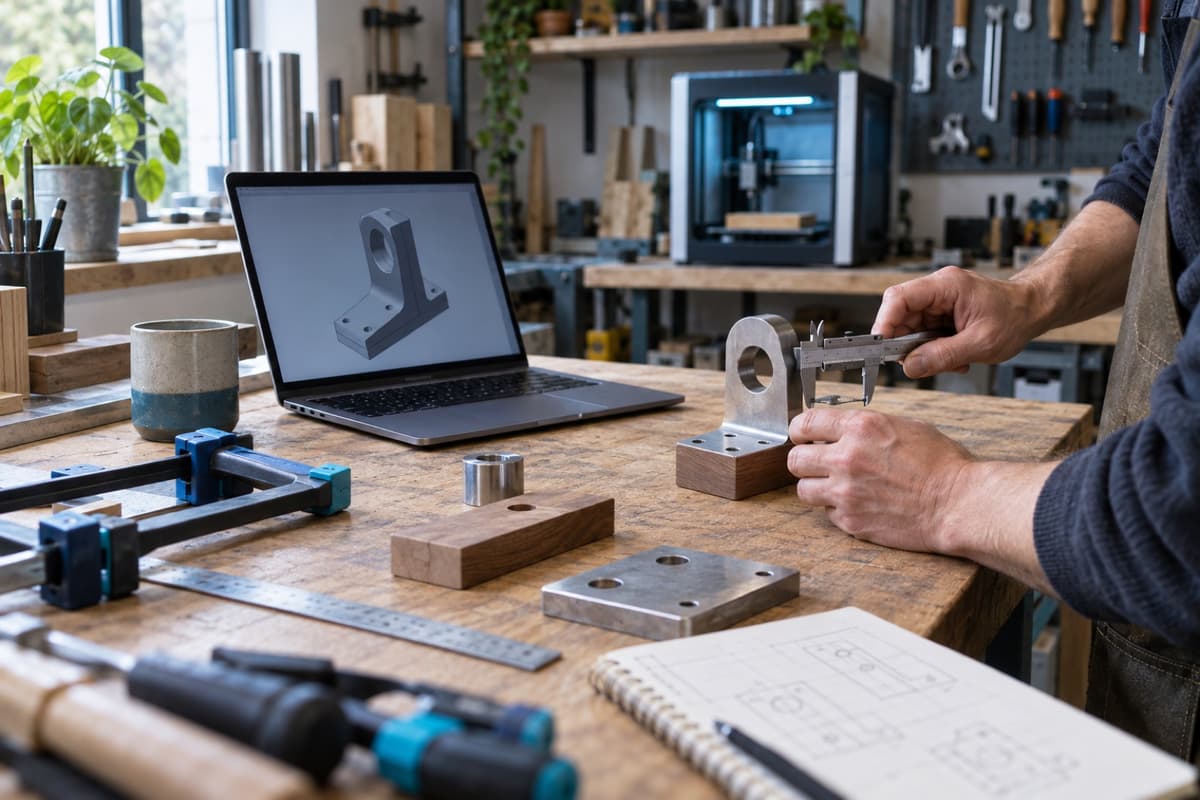
That is why workshop judgement still matters. A Maker can notice that a proposed joint will be awkward to assemble, that a repair needs access from the other side, or that a surface finish will show every mark. They can ask what the object is for, where it will live and what matters most to the Customer. Those questions turn an image into a practical Project.
Measurement and testing matter for the same reason. A prototype may reveal that a part flexes, catches, feels uncomfortable or simply looks wrong at full size. None of this makes the digital idea useless. It makes iteration valuable.
Good use starts with a clear question
The most useful question is not, “Can AI design this for me?” It is, “Which part of this Project could a digital tool help us understand?”
It might help generate an initial list of requirements. It might summarise alternative materials for further investigation, although the Maker must verify any technical claim. It might make it easier to compare versions, record decisions or explain a proposed change. In a production setting, it might help identify anomalies in data, provided the system has reliable information and appropriate oversight.
This is close to the “scan, pilot, scale” route proposed in the government's manufacturing plan: identify a worthwhile use, test it in realistic conditions, then expand only when the evidence supports doing so. A household Project does not need enterprise terminology, but the principle travels well. Start small, check the result and do not confuse a plausible answer with a proven one.
What a Customer should bring
If you use AI while developing an idea, keep the useful evidence alongside the polished output:
- State what the object must do, not only what it should look like.
- Include real dimensions and photographs of the space, part or damaged item.
- Mark generated images as references, not measured drawings.
- Explain your preferred material, budget and timing, while leaving room for alternatives.
- Identify any feature that affects safety, power, load, children or outdoor use.
- Be ready for the Maker to challenge the first concept.
The last point is a strength. A Maker who asks difficult questions is helping to expose risk before material and time are committed.
What a Maker adds
For Makers, AI literacy is becoming another workshop skill, but it sits beside material knowledge, process experience and communication. The government's 2026 skills assessment for advanced manufacturing says roles are becoming more hybrid, with people overseeing digital systems and retaining human sign-off for safety-critical decisions. It also identifies problem framing, communication, governance and confidentiality as important skills.
That combination matters to independent Makers too. Customer information, drawings and original ideas should not be dropped into unfamiliar tools without understanding how the service handles data. Generated suggestions should be checked. Decisions should remain traceable. The Maker remains responsible for their own professional judgement and for explaining uncertainty honestly.
The opportunity is better collaboration
AI may speed up a few steps, widen the range of options considered or help someone express an idea. It does not remove the need to define the Project, choose materials, test assumptions and make trade-offs. The most promising future is therefore not automated making with people pushed aside. It is a better conversation between Customer, Maker and tool.
That is also a useful way to approach Need It Made. Bring the idea, reference image or problem you are trying to solve. Describe the outcome and constraints as clearly as you can. Makers can then consider the Project and, where it fits their capabilities, help turn an interesting possibility into something grounded in the real world.
Sources
- Office for National Statistics: Artificial intelligence in UK businesses, 2023 to 2026
- Department for Science, Innovation and Technology: AI Adoption Plan, Advanced Manufacturing
- Make UK: AI, Skills and the Future of the UK Manufacturing Sector
- Skills England: Sector Skills Needs Assessment, Advanced manufacturing