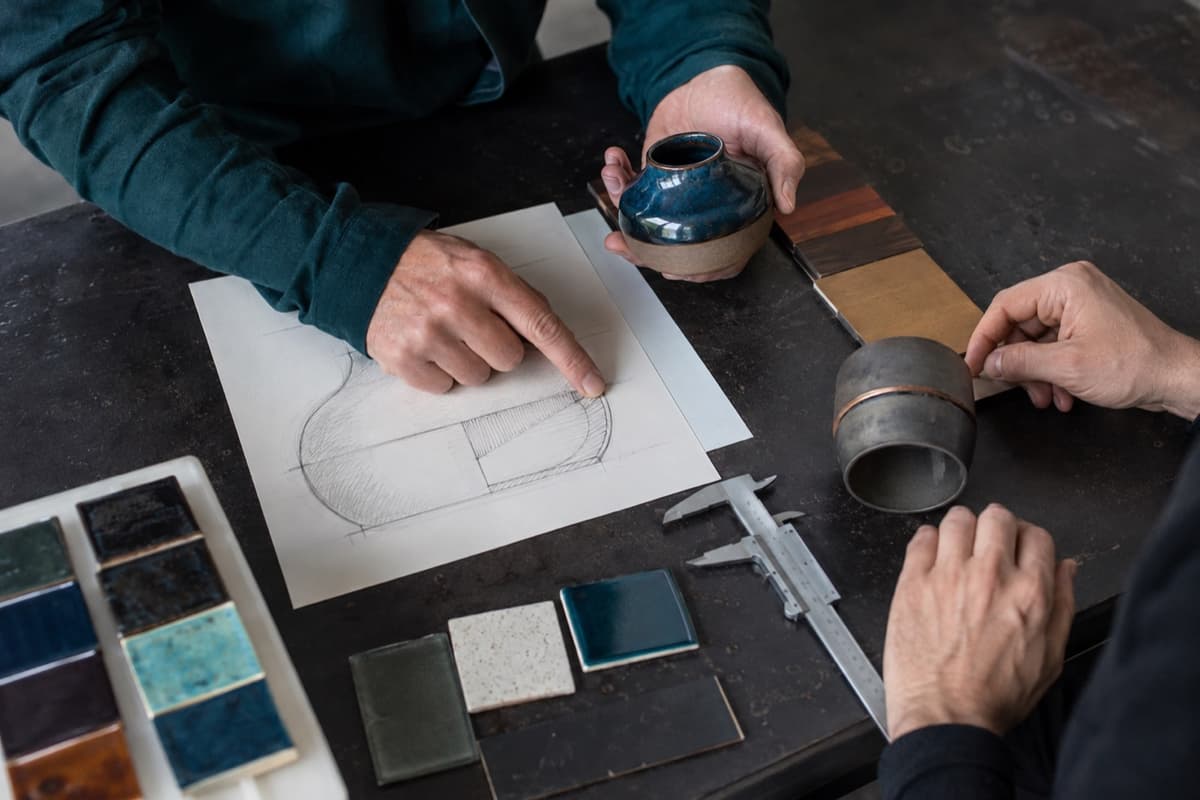
Finished objects can hide the decisions that made them possible. A ceramic bowl does not immediately reveal the tests behind its glaze. A woven textile conceals hours of sampling. A piece of furniture may look simple only because its proportions, joints and finish have been resolved carefully.
That hidden work comes into view when people can see several forms of making together and hear Makers explain their processes. From 9 to 20 September, Design-Nation's Crafted Futures exhibition is scheduled to bring 35 UK-based designer-makers to the OXO Gallery in London. Official listings say the work spans ceramics, jewellery, textiles, glass, wood, lighting, paper, fibre and metal, with pieces available to buy directly from their makers and a programme of free Meet the Maker talks.
The event is one exhibition, not a picture of every independent maker in the UK. Its breadth still offers a useful lesson for anyone commissioning or describing a physical Project: looking closely at made objects improves the questions we ask.
Objects are evidence of process
When different materials share one room, their constraints become easier to notice. Glass can hold and allow light to pass through but demands control of heat and cooling. Clay can be formed in many ways, then changes through drying and firing. Timber has grain, movement and natural variation. Textile structure affects drape, strength and surface. Metal can be cut, formed, cast, joined and finished, each route leaving different possibilities and marks.
These are broad observations, not instructions for a specific job. The important point is that a material is never just a colour or visual style. It behaves differently and looks different during making and in use. Seeing finished work alongside samples, explanations or a Maker's account helps connect appearance with those practical decisions.
For a Customer, that can turn “I want something like this” into a better brief. Is the important feature the shape it needs to finally be, the weight it must not exceed, texture it must have, translucency, durability or evidence of handwork? Must every item be identical, or is variation welcome? Does the object need to be repaired later? A reference object becomes more useful when the reason for choosing it is clear.
Meeting the Maker changes the conversation
Design-Nation describes the exhibition as a commercial opportunity for independent makers, while the Crafts Council listing emphasises direct purchase and talks about process, materials and inspiration. Those are event claims from the organisers and listing partner. The wider interpretation is that direct explanation can add context a product label cannot carry.
A Maker can explain why a joint has a certain form, why a surface varies, which stage takes the most time or why a requested change would require a different process. That does not mean every conversation becomes a commission. It means the Customer gains a more realistic understanding of what can be changed and what gives the object its character.
This matters for one-off and small-batch work. A Customer may arrive with a fixed image of the result but an open question about how to achieve it. The Maker may see that a different material, dimension or method would satisfy the need more reliably. Good commissioning leaves room for that expertise without asking the Maker to guess what the Customer values.
A collection shows there is no single maker economy
The listed disciplines range from paper and fibres to lighting and metal. That diversity is a reminder that “making” is not one trade or production lines. Some Makers produce repeatable collections. Others focus on unique work, commissions, restoration or specialist processes. Many combine design, production, selling, teaching and administration.
Customers do not need to know this whole landscape before asking for help. They do need to make the problem visible enough for the right Maker to recognise it. Clear photographs, measurements, intended use, quantity and budget provide a starting point. References can show a direction, provided they are used to explain preferences rather than request a copy of someone else's protected design.
That last distinction matters. An exhibition is a place to learn from original work and support its makers. It is not a catalogue of designs to reproduce without permission. A good Project brief can say “I like the quiet proportions and visible joinery” without asking another Maker to imitate a particular piece.
Finish is part of function
Craft exhibitions naturally draw attention to finish, but finish is not merely decoration. A smooth edge can affect comfort. A glaze can influence cleanability. A coating may change weather resistance. A textile edge can determine how well it survives use. The correct requirement depends on the object, and safety or regulatory questions may need qualified advice.
Seeing real objects helps people notice these details before work begins. Photographs are valuable, but scale, weight, texture and reflection can be difficult to judge on a screen. Handling may not be permitted at an exhibition, yet viewing an object from several angles still reveals more than a single product image.
For Makers, showing process can also reduce ambiguity. A sample board, test piece, material swatch or photograph of an intermediate stage can help a Customer understand choices without requiring a long technical explanation. It makes approval points clearer before time and material are committed to the final piece.
Better looking leads to better briefs
Crafted Futures is scheduled as part of the 2026 London Design Festival. The official festival programme gives 12 to 20 September, while Design-Nation and the Crafts Council list the exhibition from 9 September. Anyone planning a visit should check the organiser's latest details before travelling.
The useful idea travels beyond London. Galleries, open studios, markets, degree shows and local workshops all offer chances to see how material decisions become objects. The goal is not to become an expert in every craft. It is to learn what to notice: process, scale, joins, finish, variation and the relationship between form and use.
If you have a physical idea, collect references that explain what matters and describe where the object will be used. Need It Made connects those with a Project idea with Makers who can consider how to bring it to life. A better brief begins by looking carefully at what has already been made, then asking an original question of your own.