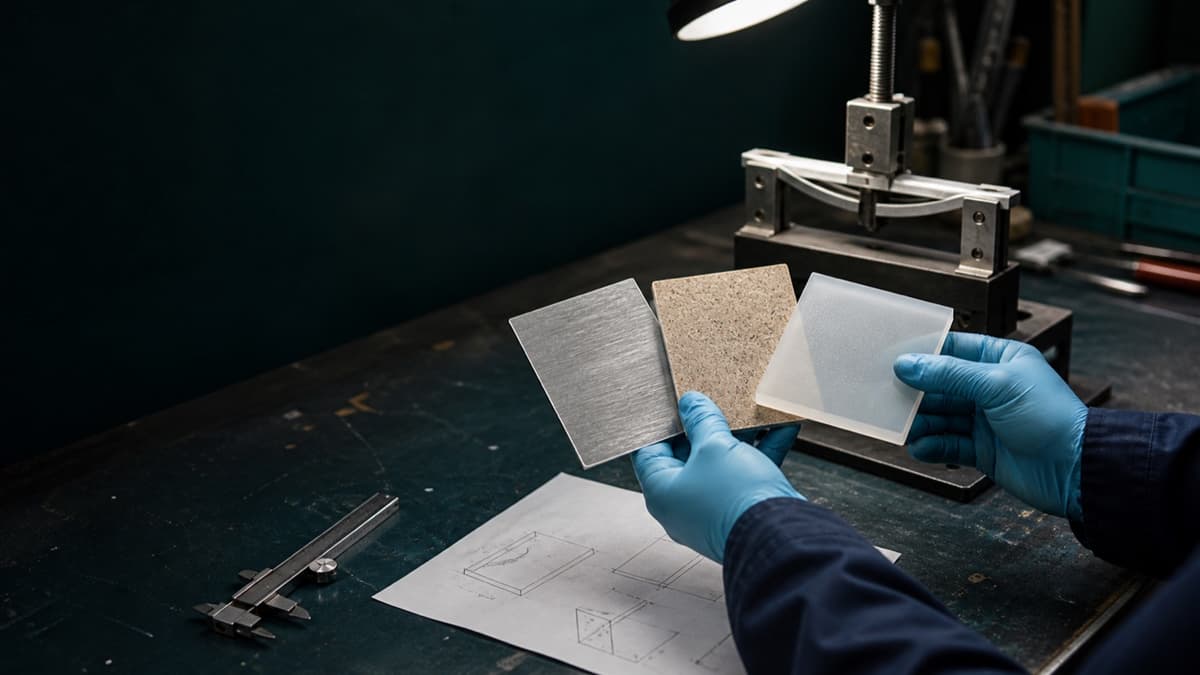
Choosing a material can sound like a late-stage decision: draw the object first, then decide whether it should be metal, plastic, fibre, ceramic or timber. In practice, the material often changes the design, the making process and even the question being asked.
That is why a new Innovate UK announcement matters beyond research laboratories. On 3 September, UK Research and Innovation said £2 million is being invested in 23 feasibility studies through the National Materials Innovation Programme. The studies cover ideas including modified copper powders for additive electronics, moulded-fibre packaging made from agricultural pulp, wool-based vacuum-formed packaging, recycled light alloys for additive manufacturing and new structural composites.
These are advanced projects, not products ready to order. Their shared first step is useful to any maker economy: establish whether an idea is technically and commercially plausible before treating it as a finished solution.
A promising material is still a set of questions
A material description rarely tells the whole story. “Recycled aluminium” does not specify the alloy, condition, thickness, finish or forming method. “Compostable plastic” does not say how it behaves under heat, moisture, impact or repeated use. “Natural-fibre composite” can cover many combinations of fibres, binders and manufacturing processes.
The same material can be excellent for one Project and unsuitable for another. A bracket used indoors has different demands from one exposed to weather. Packaging that protects a light object for one journey faces a different test from a reusable case. A decorative panel can prioritise surface finish, while a moving component may depend on wear, friction and dimensional stability.
This is editorial interpretation, but it follows the logic of feasibility work: the real question is not whether a material sounds innovative. It is whether a particular material, made by a particular process, can meet a defined need reliably enough.
Feasibility means learning before scaling
UKRI says the funded studies will help businesses assess technical and commercial potential and build evidence for future development. That distinction matters. A feasibility study is not proof that a product will succeed, enter production or deliver every hoped-for benefit.
It is a disciplined way to reduce uncertainty. A team might make sample coupons, compare processing temperatures, test bending or impact, examine surface durability, measure repeatability, estimate production costs or discover that the original route needs changing. A failed sample can be useful if it reveals the limit early, before expensive tooling or a large material order.
The programme list makes the breadth of this work visible. Some studies focus on energy or healthcare. Others investigate packaging, construction, electronic materials and products made from recycled feedstock. The common thread is movement from an interesting material idea towards evidence about how it behaves in the real world.
The workshop version of the material question
Makers often meet the same problem at a smaller scale. A Customer may request “a plastic copy”, “a stronger metal version” or “something sustainable”. Those phrases describe an intention, not a complete specification.
A Maker needs to ask what the object does, where it lives and how it can fail. Does it carry weight? Flex repeatedly? Touch food? Sit outdoors? Need electrical insulation? Match an existing colour? Survive cleaning chemicals? Remain repairable? Some answers may require specialist or regulatory advice, and a marketplace cannot replace that expertise.
The first practical step may be a cheap sample rather than a polished final object. A small printed section can check fit. A simple timber mock-up can test size and reach. Two sheet materials can be bent or fastened in the intended way. A finish can be tried on an offcut. These tests do not certify performance, but they can expose obvious mismatches and help the Customer and Maker improve the brief.
Process and material belong together
Materials cannot be separated from the way they are made. A shape that is straightforward to machine may be awkward to mould. A fibre-based material may need different radii or wall thicknesses from a conventional plastic. Additive manufacturing can enable forms that are difficult to cut, but the printed orientation and finishing route may affect the result.
This is one reason the new studies include both material ideas and processing approaches. The titles refer to hot extrusion, vacuum forming, moulded fibre, additive technology and co-moulding. The programme is not simply searching for new substances. It is exploring workable combinations of material, process and use.
For a small Project, that can change the conversation from “What material is best?” to “What combination can this Maker source, shape, join and finish for this particular job?” The second question is less glamorous, but far more useful.
Better briefs leave room for evidence
Customers do not need to arrive with a material science qualification. A strong starting brief describes the outcome and constraints: dimensions, loads, environment, appearance, quantity, budget and what matters most. An existing broken part, clear photographs or a reference object can add context.
It also helps to separate requirements from preferences. “Must not rust outdoors” is a requirement. “I imagined aluminium” may only be a preference. A Maker can then explain feasible alternatives, what needs testing and where a specialist opinion is necessary.
The 23 studies announced this week operate at a different scale from most everyday Projects, but they reinforce a shared principle. Making is not only the act of producing an object. It is the work of turning uncertain choices into evidence, then using that evidence to decide what should be made next.
If you have a physical idea, start by describing what it must do and where it will be used. Need It Made connects those with a Project idea with Makers who can consider how to bring it to life, including the material questions that shape the route.