Something important changed for adult learners in England on 1 August. The government expanded its Free Courses for Jobs offer to include more Level 2 engineering and manufacturing qualifications. The official announcement lists 49 reformed engineering qualifications and 23 reformed manufacturing technologies qualifications.
That sounds like a training-policy story. It is also a maker-economy story. Behind every repaired assembly, accurate bracket, useful prototype and small production run is a chain of practical decisions. Someone has to read the drawing, understand the material, choose a process, measure the result and recognise when it is wrong.
Digital systems can support that work, but they do not remove the need for it. As UK manufacturing adopts more automation and artificial intelligence, workshop judgement becomes more important, not less.
What has actually changed?
Free Courses for Jobs is an England-only programme. Government guidance says eligible adults aged 19 or over can study certain qualifications without paying the course fee. The standard eligibility description covers people who are unemployed or earn below £25,750, although rules can vary by area and provider. Anyone interested needs to check the current course, residency and local funding conditions rather than assume every course is free to everyone.
The latest expansion matters because Level 2 engineering and manufacturing courses can provide a practical entry point. The Department for Education says the reformed qualifications are aligned with occupational standards developed with employers. The stated aim is to help people progress towards employment in these sectors.
The list is not a promise that every qualification will be available at every local college. Funding eligibility and actual course provision are different things. Even so, widening the funded list gives providers more scope to offer training in areas where businesses need people.
The skills gap is not an abstract problem
Make UK's 2026 Shape of British Industry report found that 99% of manufacturers surveyed said access to skills would shape their future growth plans. Half identified skills shortages as their biggest current barrier to growth. The same report said 65% planned major investment in digitalisation and AI.
Those findings belong together. Buying software, sensors or automated equipment is not the same as using them well. A digital drawing still has to describe a part that can be made. A machine still needs correct material, tooling and setup. Inspection data still needs someone who understands what a tolerance means for the finished object.
Make UK's June report on AI skills adds useful detail. It found that only 2% of surveyed manufacturers said AI was widely embedded across their operations. Reported use was much more common in administrative functions than in production, supply chain or quality control, while more than half cited skills shortages as a barrier to wider adoption.
The useful lesson is not that workshops must chase every new technology. It is that practical knowledge and digital confidence increasingly have to meet in the same person or team.
Modern making still begins with physical reality
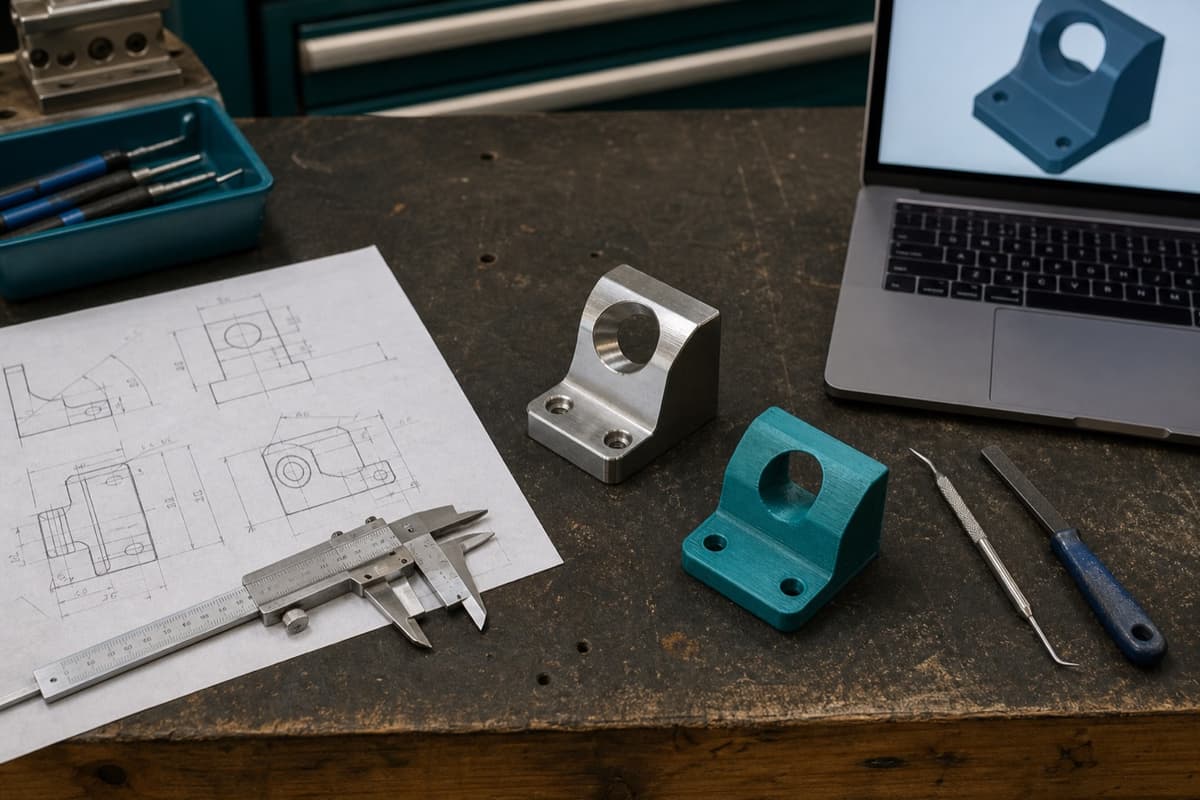
Consider a simple metal bracket. Before it becomes a finished part, someone needs to understand the load, dimensions, fixing points, material thickness and environment. A CAD model can make the geometry clear. A laser cutter or CNC machine can repeat it accurately. Inspection software can record whether the result sits inside tolerance.
But none of those steps answers the first question: what does the bracket actually need to do?
That comes from a Customer explaining the problem and a Maker translating it into a workable brief. It may require a sketch, a cardboard model, a 3D-printed test piece or a first metal version that reveals an overlooked clash. The process moves between conversation, hand skills, digital tools and physical testing.
This is why foundational skills matter. Measurement, drawing interpretation, material awareness, safe tool use, finishing and quality checking are not old-fashioned alternatives to digital manufacturing. They are what make digital manufacturing useful.
A wider route into the maker economy
Formal training is only one route into making. People also learn through apprenticeships, work, community workshops, repair groups, evening classes and years of self-directed practice. Different routes suit different circumstances, and a qualification alone does not make someone ready for every Project.
The funding change is valuable because it may remove one barrier for eligible adults who want a structured starting point or a recognised next step. For someone moving into fabrication, machining, maintenance or production, access to a funded course could help turn an interest in practical work into employable capability.
It could also strengthen the wider network around small manufacturing. Independent Makers and workshops need people who can move confidently between a drawing and a bench, between a digital model and a real material, or between a fault and a sensible repair. Those capabilities support one-off Projects and small batches as well as larger factories.
What Customers can take from this
Customers do not need to know the name of every process before describing a Project. They do benefit from making the physical requirement clear. What must the object do? What size is it? Where will it be used? Does it carry weight, move, get wet, become hot or need to match something that already exists?
Clear photographs, measurements and a plain description give a Maker somewhere to begin. From there, the Maker can identify whether the job needs design work, a prototype, fabrication, machining, repair, finishing or another specialist skill.
That translation is one of the most valuable workshop capabilities. Technology can help make the answer faster or more accurate, but practical judgement connects the original need to the finished result.
The expansion of funded training is therefore more than a new course list. It is a reminder that the UK's maker economy depends on people learning how things behave in the real world. Smarter manufacturing still needs measuring, testing, adapting and making.
If you have a physical idea or an awkward practical problem, you can describe your Project on Need It Made and give Makers the information they need to consider a route forward.