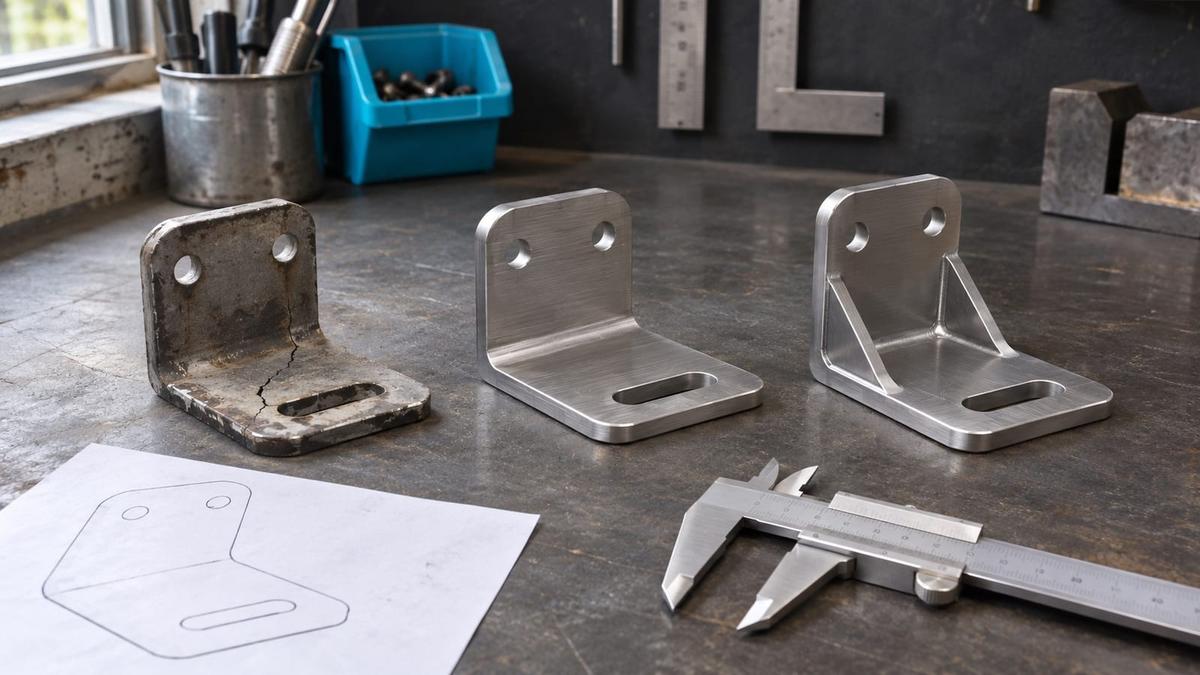
A broken hinge, cracked bracket or worn handle can make a whole object unusable. If the original spare is unavailable, it is tempting to ask for an exact copy immediately. That may be right, but it is not the only option. The original part may be repairable, its important dimensions may be recoverable, or the failure may show that a small redesign would be more useful than a faithful duplicate.
The practical question is: what evidence will help a Maker choose the safest sensible route?
Short answer
Repair is worth exploring when most of the original part remains sound and its function can be restored without hiding a safety problem. Reproduction suits a proven part whose shape, interfaces and material requirements can be understood. Redesign becomes relevant when the original repeatedly failed, the old material or process is unavailable, or the surrounding object has changed. The decision depends on use, load, environment, measurements, failure evidence and acceptable risk, not appearance alone.
What is the difference between repair, reproduction and redesign?
Repair keeps the original part and restores it. That might involve joining, rebuilding or replacing a local damaged area. It can preserve fit and character, especially where the surviving part already contains hard-to-measure geometry.
Reproduction makes a replacement intended to perform the same role. It is not necessarily a literal copy. A Maker may need to translate an old casting, moulding or fabricated part into a process available today while preserving the dimensions and features that matter.
Redesign changes the part or its relationship with the surrounding object. The aim may be to remove a weak point, make future maintenance easier, suit a different manufacturing process or accommodate a component that can still be bought.
Start with what the part actually does
A useful brief describes function before proposing a process. Does the part locate, support, seal, guide, grip, protect or transmit movement? Which faces touch another component? What must move freely, and what must stay fixed? Is the part exposed to heat, water, chemicals, sunlight, vibration or repeated impact?
Photographs should show the complete object, the part in position, the damaged area and nearby fixings. Include a ruler or known reference where practical, but do not rely on one perspective photograph for precise dimensions. If fragments exist, retain and photograph them. Marks, labels, model numbers, manuals and an original drawing can all help.
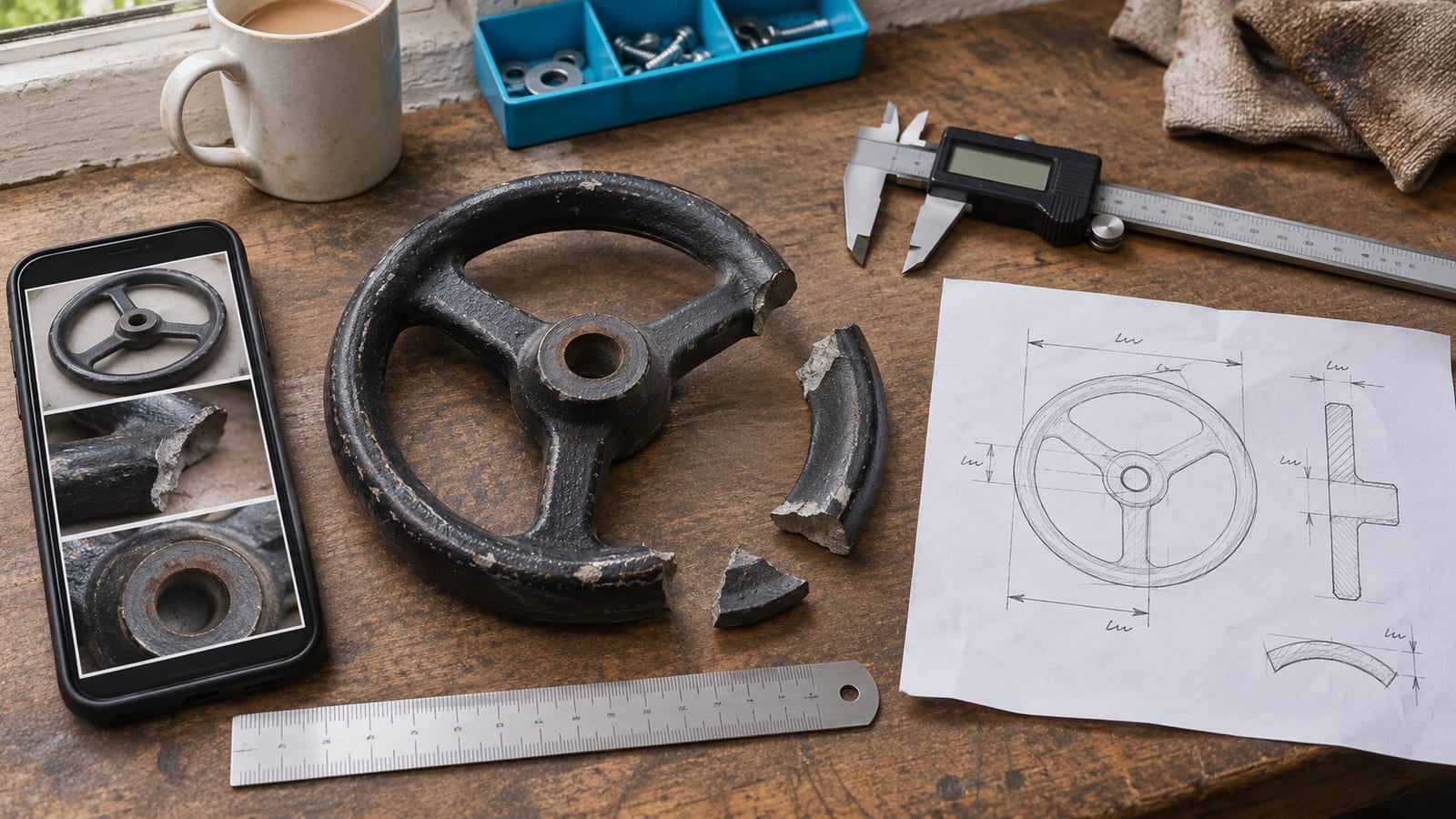
Need It Made's editorial view is that a useful replacement-part brief should separate three things: what is known, what can be measured, and what still needs to be tested. That is more valuable than presenting an early guess as a finished specification.
Read the failure before copying the shape
The broken surface may contain information. A single accidental impact is different from a crack that returned after repeated use. Wear on one side can indicate misalignment. Distortion may suggest excessive load or heat. Corrosion may mean that the environment matters as much as the dimensions.
Do not clean, glue or grind away evidence before taking clear photographs unless a competent person says it is necessary. Record how the failure happened, whether it happened before, how old the part is and whether anything else changed. If the object became unsafe, stop using it.
For workplace equipment, the Health and Safety Executive says maintenance should be planned and carried out by competent people, with particular attention to manufacturer instructions and safety-critical features. HSE also distinguishes simple refurbishment from substantial machinery modification. A major change of function or performance can create different obligations and new hazards. That is why a safety-critical guard, lifting component, pressure part, vehicle part, electrical enclosure or load-bearing structure should not be treated as an ordinary copying exercise.
When is repair the stronger option?
Repair may be attractive when the original is mostly intact, its material can be identified, access is possible and the damaged area can be restored without compromising a critical function. It can also retain original surface detail or fit that would be costly to recreate.
Questions for a Maker include whether the repair area can be prepared properly, whether joining will introduce heat or distortion, and how the result can be inspected or tested. A cosmetic repair and a structural repair are not the same. If failure could injure someone or damage property, the relevant competent specialist or original manufacturer may be the right starting point.
When does reproduction make sense?
Reproduction is strongest when the original design worked, the interfaces can be captured and a suitable material and process are available. The Maker needs the dimensions that control fit, not a measurement of every visible surface. Hole centres, shaft sizes, mating faces, clearances, threads and movement paths can matter more than decorative contours.
When should redesign be discussed?
Redesign is worth discussing when the part has failed repeatedly, replacement materials or components differ, maintenance access is poor, or an exact copy would reproduce an obvious weakness. It may also make sense where one unavailable proprietary element can be replaced with a standard component.
Keep the change proportionate. State the problem, proposed difference and how it will be checked. A fit prototype may test clearance, but cannot prove long-term strength or safe performance.
A brief a Maker can assess
Before posting a Project, gather:
- the object, manufacturer, model and approximate age;
- photographs of the whole object, installed part, damage, fragments and markings;
- the part's function and what happens if it fails;
- key dimensions, with the measuring method and uncertainty;
- known material information and service environment;
- the failure history, previous repairs and any changes around the part;
- the quantity required and whether appearance matters;
- any manual, drawing, original spare number or manufacturer advice;
- what must be verified before the object returns to use.
Do not dismantle, measure or test anything in a way that exposes you to electricity, stored energy, pressure, hazardous substances, unstable loads or moving machinery. Where safety or compliance is material, seek an appropriately competent professional.
The next useful question
An unavailable part is not automatically a dead end, and an exact copy is not automatically the answer. A clear record of function, fit, failure and uncertainty gives a Maker something useful to assess. Need It Made connects UK Customers with independent Makers who may be able to help with one-off and small-batch Projects. Tell us about your Project, including what the part does and what evidence you already have.